skip to main |
skip to sidebar
I had the distinct pleasure of attending an event that I have never attended before. I noticed the the newspaper that the Blue Ridge Orchid Society was holding a show on October 10th and 11th at the Roanoke Council of Garden Clubs facility on Colonial Avenue in SW Roanoke County. Since I have been spending a bit of time photographing wildflowers lately, I figured I would check this event for some unusual flowers. Well, I was not disappointed. These orchids have some of the oddest coloration and shapes that I have ever seen in a flower. They were beautiful, and intensely interesting. I am told that orchids can be very difficult to grow, but you could not tell that from the variety of flowers displayed at this event. I wish to thank Denise Gresham of the Blue Ridge Orchid Society for spending her time to help me identify these Orchids. The Blue Ridge Orchid Society is a really nice group of people, and if you are interested in their group, their next meeting is
November 9, 2008 at the Roanoke Council of Garden Clubs. This orchid is called Vanda Robert's Delight
 This variety is called Odcdm Crowborough 'Spice Island'
 This orchid has marking that looks to me like Eddie, the dog from the Frasier TV show, wearing sunglasses. This variety is know as Odm Midnight Miracle
 I really like the colors of this orchid, known as Dtps. Lonnie Morris
 This Orchid has a long name. It is Ascda. Gou Che Long x V. Black Magic
 This Orchid is truly graceful. It is called Lc. Wolterae
 This variety is known as Den. Emma White
  This Orchid is called V. Josephine Van Brero x V. Southeast Beauty
I have been photographing wildflowers like a crazy person for the past 3 months. I don't know what I am photographing, most of the time, but I know what looks good through my camera. Then I research what I can, and post them here. Often, I ask for help from viewers of this blog. I would like to take time to thank Katherine Hix for her ongoing assistance in helping to identify these flowers. She has been a very accurate resource for finding the genus and species of these wildflowers. Katherine, Thank you for the help. I do appreciate it.
It was another nice day in Roanoke, and though not as cool as it has been in the past week, it was not too hot either. So, I took the opportunity to head to Smith Mountain Lake for the day. The wildflowers below are what I found either along the roadsides, or at Smith Mountain Lake.


 The flowers above, as best I can tell, are Coreopsis ariculata, also known as Nana Coreopsis.
 The flowers above are called Everlasting Pea, or Lathyrus latifolius. These grow in large clumps of vines.
 The flowers above are the relatively easy to find Black-eyed Susan, or Rudbeckia hirta.
 This flower is known as a Lance-leaved Coreopsis, Coreopsis lanceolata.
I'm sorry. I really am enjoying getting out and photographing the wildflowers in the surrounding area. I made a trip a bit south on the Blue Ridge Parkway to try to catch the bloom of the Grey's Lily. Over 20 years ago, a Parkway Ranger told me that he had seen a Grey's Lily blooming just off the Blue Ridge Parkway. The Grey's Liliy is a very rare lily, and is almost exclusively found in the Blue Ridge and Appalachian Mountains of North Carolina, on higher altitude balds and rocky soil. Finding one this far north, in Virginia, would be an awesome thing. I guess I'll keep looking. While I was driving around on the Parkway, using my four dollar a gallon gas, I decided to hunt for a few more wildflowers. Being late spring, early summer, the abundance of wildflowers has dropped, but they still can be found, and photographed. Here is a bit of what I found on June 17, 18, and 19, 2008.
 This is a Deptford Pink (Dianthus armeria). Not a native Virginia wildflower, it is actually native to England. I saw it all alone on the side of the Blue Ridge Parkway. I looked a quarter mile around this flower, and found no others.
 This is, again, the OxEye Daisy (Leucanthemum vulgare). These are still quite numerous along the Parkway.


 The above images are on the Canadian Dwarf Cinquefoil. These are some of my favorite flowers to photograph.
 If anyone knows what this flower is, please let me know.
 The above orange cluster of flowers is known as Butterfly Weed
 This beautiful flower is the Day Lily. Now, if I can find its cousin, Grey's Lily.
 This is Dame's Rocket (Hesperis matronalis).
 This wildflower is the Wild Bergamot, early in it bloom. It is also known as Bee Balm. Thanks to Cheryl Kessler in identifying this for me.
 This wildflower is called a Thread-Leaved Coreopsis, (Coreopsis verticillata).
 The above wildflowers are Mayweed. My first images of this particular wildflower.
 A butterfly enjoys the offerings of the Wild Bergamot.
 Again, our friend, the OxEye Daisy.
 The above wildflowers are in the wildflower areas along Interstate 581. Not strictly defined as a wildflower, these are a hybrid Day Lily, called "Stella d'Oro". It is a variety of the wild Day Lily seen above.
 These are called "Rose of Sharon", and are Hibuscus Syriacus. They can be a pervasive, nuisance species if they get out of control.
Mill Mountain has the Star, the Zoo, the Discovery Center, and a wonderful, lesser used area called the Wildflower Garden. A series of trails traverse the garden, as a large assortment of wildflowers bloom throughout the year. It is definitely worth the time spent there, and worth the trip to get there. Here are some images from the Mill Mountain Wildflower Garden, as well as from the Mill Mountain area. I have not identified all of the flowers below, so if you can help, send me a comment.
 The Pink Azalea is a staple wildflower in the spring on the Blue Ridge Mountains
.
 The Golden Star (Chrysogonum virginianum) prefers moist, shady woodlands.
 Just don't ever forget Forget-Me-Nots (Myosotis scorpiodes). Just an incredible shade of blue.They prefer streamsides and wet places.
 The Star of Bethlehem (Ornithogalum umbellatum). This flower is one of my favorites, although it can be considered a nuisance species if left uncontrolled.
 The white Mountain Laurel (Kalmia latifolia) is a prevalent wildflower in the spring on the Blue Ridge Mountains
.
 The Hellebore (Veratrum viride) is a green wildflower that prefers swamps, wet woodlands and wet meadows.
 This is Dame's Rocket (Hesperis matronalis). This group in in white, but can be found in many other colors.
 The Flame Azalea (Rhododendron calendulaceum) is my favorite Azalea.
 I believe this is White Cranesbill Geranium (Geranium sanguineum)
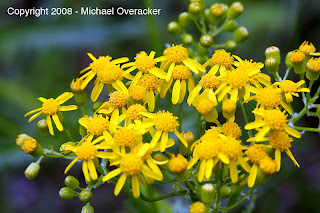 Above are a couple of images of Golden Ragwort (Packera aurea). Rough name for an attractive wildflower.

 The Ox Eye Daisy (Leucanthemum vulgare) is relatively easy to find along the Parkway.
 The Philadelphia Fleabane (Erigeron philadelphicus) is similar to the Daisy Fleabane, but has more petals and a pink color to the outside of the flower.
 Wild Blackberry (Wild Black Raspberry)
 The Canadian Dwarf Cinquefoil is similar to the Rough-Fruited Cinquefoil, but the leaves of the Canadian Dwarf variety have serrated edges
.
 The Yellow Hawkweed (Hieracium caespitosum) prefers pastures and roadsides.
 This is Frostweed (Verbesina virginica)
 Wild Strawberry (Fragaria virginiana)
 This orchid is called Vanda Robert's Delight
 This variety is called Odcdm Crowborough 'Spice Island'
 This orchid has marking that looks to me like Eddie, the dog from the Frasier TV show, wearing sunglasses. This variety is know as Odm Midnight Miracle
 I really like the colors of this orchid, known as Dtps. Lonnie Morris
 This Orchid has a long name. It is Ascda. Gou Che Long x V. Black Magic
 This Orchid is truly graceful. It is called Lc. Wolterae
 This variety is known as Den. Emma White
  This Orchid is called V. Josephine Van Brero x V. Southeast Beauty


