skip to main |
skip to sidebar
Here we go. It is a cold, rainy, fall evening, and I have worked up some more images that I had shot a while back. These images were shot on September 5, 2009, and were taken along Colonial Avenue in SW Roanoke County, at the Roanoke Valley Garden Club grounds, and around my house, where wildflowers have seemed to bloom in abundance this year. Some I planted, but most I did not plant, and have just grown wild, knowing that I would photograph them. Smart little buggers, those wildflowers. Most of these images were taken with a bit of a wind blowing. Thank goodness for fast shutter speeds. Also, I manually focus and manually set the exposures on all of my images. There is never any autofocus and auto exposure going on when I shoot wildflowers.
 This wildflower is a Black-eyed Susan (Rudbeckia hirta), and is a member of the Aster family.
 This wildflower is a Oxeye Daisy (Leucanthemum vulgare), and is also a member of the Aster family.
 A few more Oxeye Daisy (Leucanthemum vulgare).
 This wildflower is known as Chicory (Cichorium intybus), and is very easy to find in this area towards the fall. It is a member of the Aster family, and I really liked the soft pastel blue color of this bloom.
 This wildflower is also Chicory (Cichorium intybus), but this bloom is colored more like the majority of these blooms. These are really beautiful flowers.
 This wildflower is Sweet Goldenrod (Solidago odora). If you look closely at the honeybee, it is holding on to the flower for dear life. The wind was blowing hard, and stopping the action was a real test of my ability.
 This wildflower is called Hairy Beardtongue (Penstemon hirsutus). Very different looking, and a member of the Figwort family.
 This wildflower is known as Woodland Phlox, Wild Blue Phlox, or Wild Sweet William
(Phlox divaricata). A big thanks to Nick Leitch and his wife for helping me identify this wildflower.


 The four wildflowers above are color variants of the Lance-leaved Coreopsis (Coreopsis lanceolata). It is also known as Tickseed, but I don't think that name does this beautiful wildflower justice.
 This wildflower is called Bushy Aster (Aster dumosus). It is distinguished by long, slender, lance-like leaves.
 I do not know what this wildflower is. Any help would be appreciated.
Hey Folks,My apologies for the lack of recent posts. I have been shooting quite a bit, but I have not had the time to post. Now that the major part of the wildflower blooming season is over, I will try to get to posting some pics. I have about 2000 images to go through and identify. So keep checking back here for some more pics coming soon.
Yep. I just cannot stay away from this place. The Mill Mountain Wildflower Garden is one of the most underrated tourist destinations in the Roanoke area. This place is a wonder just about all year long, and you can come up every couple of weeks and it seems to change with each visit. If you have not walked through this wonderland of wildflowers, you should do so soon. I find my troubles seem to melt away when I walk through and visit. Try it sometime, and see some of the flowers I have photographed below. This wildflower is Joe-Pye Weed, (Eupatorium purpureum).
 This wildflower is known as Blazing Star, or Snakeroot, (Liatris spicata).
 This wildflower is a Thread-Leaved Coreopsis, (Coreopsis verticillata).
 This flower is Bouncing Bet, or Soapwort (Saponaria officinalis) The roots, when soaked in water, provided a soapy alternative used by pioneers to wash silks and woolens.
 This wildflower is a Purple Coneflower, (Echinacea purpurea).
 This wildflower is a Blackberry Lily, (Belamcanda chinensis).
 This flower is known as Heal-All or Self-Heal (Prunella vulgaris).
It is a member of the Mint family.
 This wildflower is known as Tall Hawkweed, (Hieracium piloselloides). This plant is much less common than its smaller cousin, Mouse-Eared Hawkweed.
 This wildflower is a Golden Star, (Chrysogonum virginianum).
 This wildflower is also a Golden Star, but with a slightly different petal variation.
(Chrysogonum virginianum).
Hello friends. I apologize for the time span between posts, but I have been busy shooting and dealing with other needs. However, on this occasion, I must post a few pics, plus some history.
About 25 years ago, while I was working as a VIP for the Blue Ridge Parkway, I was told of a rare lily that was found in Virginia along the parkway. It is called a Gray's Lily (Lilium grayi). This rare lily is seldom seen outside of an area in the high mountain balds and pastures in North Carolina. It is found on occasion in other areas, but not very far from these high balds. This sighting was quite a bit north on the normal range for this wildflower. I went to where it was sighted, but could not find it. I decided that day, 25 years or so ago, that I would find the Gray's Lily in Virginia. I have been looking since, some times more intensely than others.
The other night, I received a call from a friend. He informed me that he had found what he thought was a Gray's Lily along the Blue Ridge Parkway in Virginia. He was not positive that it was a Gray's Lily, and asked if I could check it out and photograph it. I set out the next morning, and found it right where he said it would be. Sure enough, there it stood. Not one, but two (as best I could tell) Gray's Lily plants. The blooms where already starting to wither away, but I had waited 25 years to see this wildflower in Virginia, so I photographed it anyway. Even past its prime, it was a beautiful site. This endangered wildflower was right in front of me and my camera. It was a marked end to a long quest. Hopefully, it will return next year, and maybe spawn a few more plants. This beautiful flower is one that everyone should see.
I will not reveal the location of this wildflower to protect it.
 Here it is. The Gray's Lily (Lilium grayi). It is past its bloom prime, but it is still beautiful to me.
 The Gray's Lily (Lilium grayi), with a darker background.
My apologies for the break in posting. I have been shooting frequently, and working on many other projects, as well as working at the house and building a new wildflower garden. So, now I am trying to catch up, and post some of the images that I captured in the past month. These images were taken between May 17, 2009 and May 21, 2009. Theye were shot in Roanoke County, Franklin County, and the Blue Ridge Parkway.
 This wildflower is Mayweed (Athemis cotula). It is relatively easy to find growing in fields and unmaintained tracts of land.
 This wildflower is Yellow Wood Sorrel (Oxalis stricta). It is moderately easy to find along roadsides.
 This wildflower is Philadelphia Fleabane (Erigeron philadelphicus). It is similar to Daisy Fleabane, but this variety has finer petals that are several layers deep.
 This wildflower is the OxEye Daisy (Leucanthemum vulgare). It looks like Mayweed, but the petals are more overlapped and several layers deep.
 This wildflower is Crown Vetch (Coronilla varia L). It is considered and invasive species, but it does a great job of ground cover and erosion control.
 This wildflower is Golden Ragwort (Senecio aureus).
 This wildflower is Bowman's Root (Gillenia trifoliata). It is also known as Indian Physic and Fawn's Breath. It is commonly found on moist hillsides and on the edges of forested land.
 This wildflower is Mountain Laurel (Kalmia latifolia). It is also known as Spoonwood. It is common in this area along wooded breaks.
 Another image of Philadelphia Fleabane (Erigeron philadelphicus). I find this wildflower extremely interesting and very photogenic
.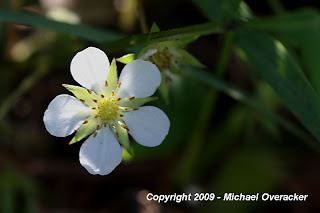 This wildflower is Wild Strawberry (Fragaria virginiana). It is easily identifed by the large star amongst the white petals
. This wildflower is Indian Strawberry (Duchesnea indica). It is very similar to the Wild Strawberry above, except the large star is amongst the yellow petals.
 This wildflower is Common Speedwell (Veronica officinalis). It is dry fields and open woods. The blooms are very small, and look similar to Corn Speedwell.
 This wildflower is Bladder Campion (Silene vulgaris). It is found growing in fields and on roadsides.
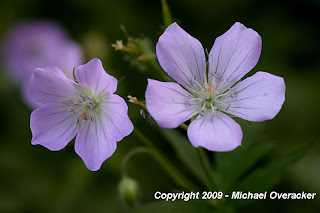 This wildflower is Wild Geranium (Geranium maculatum). I do not see them often, but when I do, they are in large clusters of plants.
 This wildflower is a Black-eyed Susan (Rudbeckia hirta), and is a member of the Aster family.
 This wildflower is a Oxeye Daisy (Leucanthemum vulgare), and is also a member of the Aster family.
 A few more Oxeye Daisy (Leucanthemum vulgare).
 This wildflower is known as Chicory (Cichorium intybus), and is very easy to find in this area towards the fall. It is a member of the Aster family, and I really liked the soft pastel blue color of this bloom.
 This wildflower is also Chicory (Cichorium intybus), but this bloom is colored more like the majority of these blooms. These are really beautiful flowers.
 This wildflower is Sweet Goldenrod (Solidago odora). If you look closely at the honeybee, it is holding on to the flower for dear life. The wind was blowing hard, and stopping the action was a real test of my ability.
 This wildflower is called Hairy Beardtongue (Penstemon hirsutus). Very different looking, and a member of the Figwort family.
 This wildflower is known as Woodland Phlox, Wild Blue Phlox, or Wild Sweet William


 The four wildflowers above are color variants of the Lance-leaved Coreopsis (Coreopsis lanceolata). It is also known as Tickseed, but I don't think that name does this beautiful wildflower justice.
 This wildflower is called Bushy Aster (Aster dumosus). It is distinguished by long, slender, lance-like leaves.
 I do not know what this wildflower is. Any help would be appreciated.


